
AI-ML in Health Care
Improving the ventilator management for ICU patients
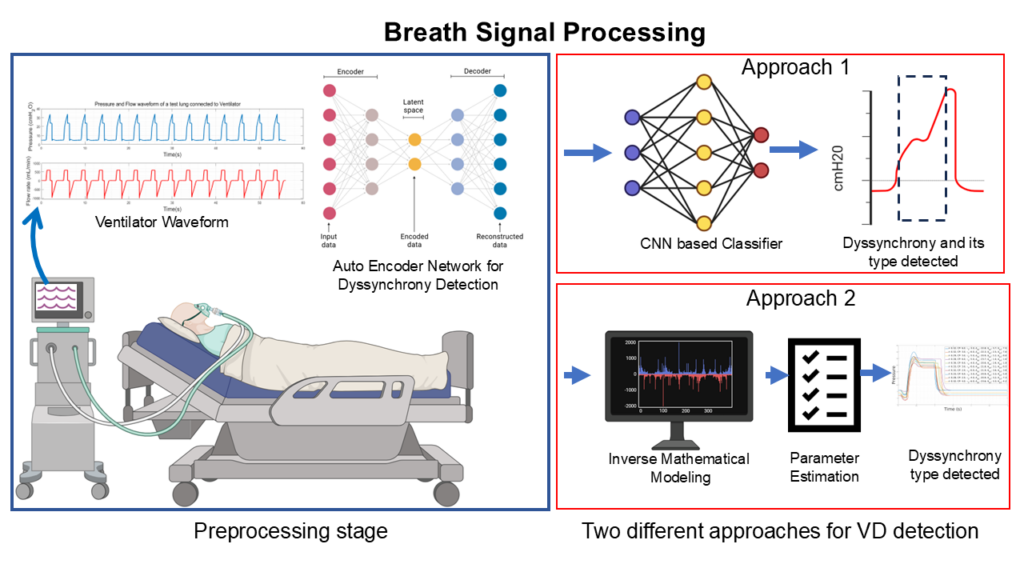
While invasive mechanical ventilation is a lifesaving intervention, it can cause ventilator-induced lung injury (VILI). A significant factor contributing to VILI is ventilator dyssynchrony (VD), which occurs when patient respiratory efforts are not aligned with ventilator support, leading to high mortality in ICU patients with acute respiratory conditions. The challenge lies in the inability to accurately label and characterize VD in large datasets, preventing effective intervention to reduce VILI.
To address this, Breath Signal Processing outlines a method for detecting and classifying ventilator dyssynchrony using pressure and flow signals collected from the ventilator. A Dyssynchrony Detector processes the data with an autoencoder model to identify anomalies, which are then further analyzed by a Dyssynchrony Classifier based on a Convolutional Neural Network (CNN) to specify the type of dyssynchrony. This approach enhances the monitoring of respiratory conditions and enables timely clinical interventions.
Developing AI-ML based pipeline to automate the detection of Hirschsprung disease using histopathological images
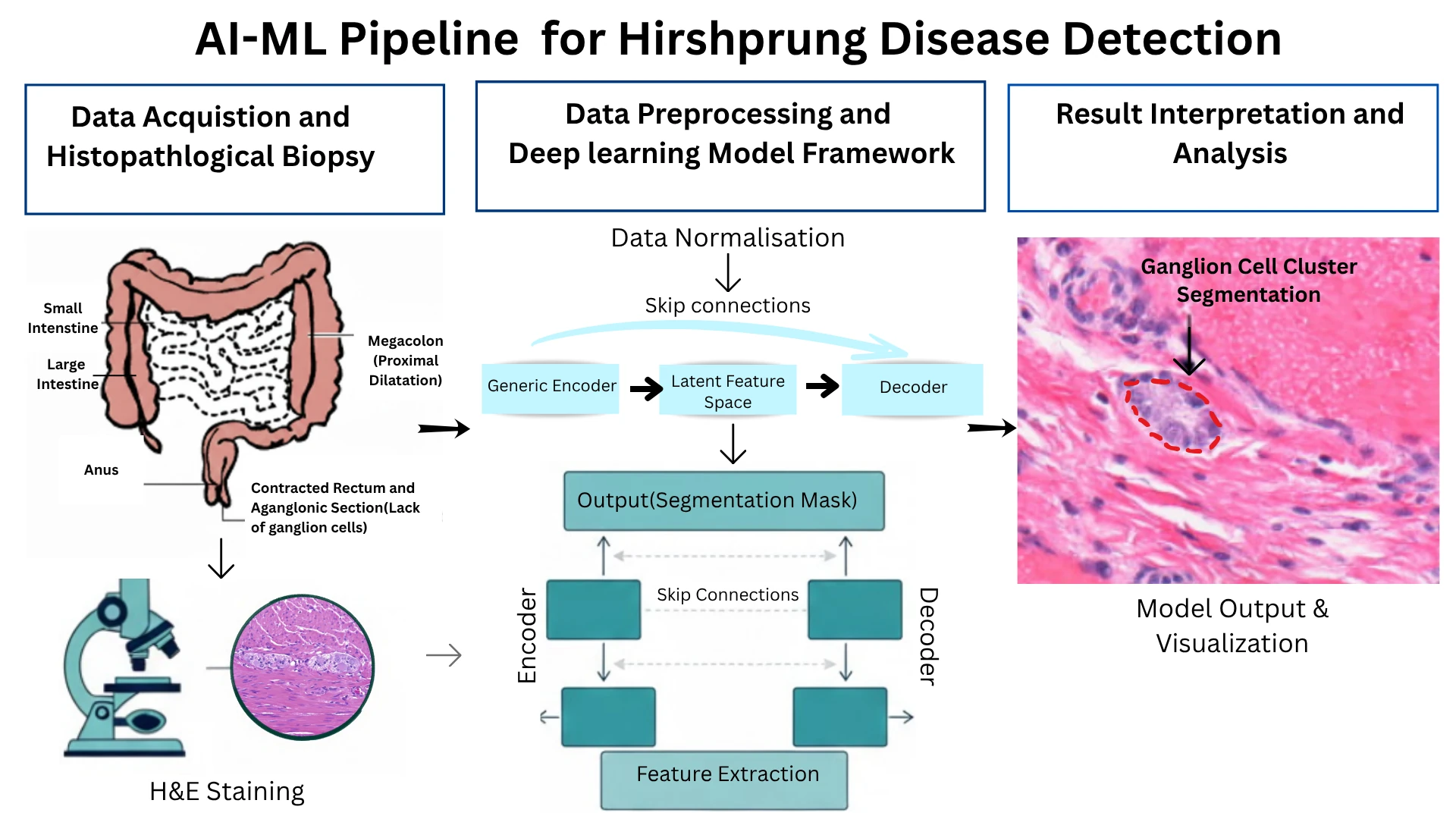
Hirschsprung disease (HD) is a congenital condition marked by the absence of ganglion cells in the colon, causing functional obstruction. Traditionally diagnosed through histopathological examination of biopsy specimens, advancements in machine learning (ML) present innovative approaches for enhancing the detection of HD via the analysis of histopathological images. ML automates image analysis, improving diagnosis efficiency, consistency, and accuracy.
Developing ML models involves collecting annotated histopathological images, normalizing and augmenting data, and using convolutional neural networks (CNNs) for feature extraction. The models are trained using supervised learning techniques and evaluated for sensitivity and specificity. A user-friendly interface can facilitate the deployment of these models, allowing pathologists to receive automated assessments.
Developing data driven mathematical model to decode ECG signals
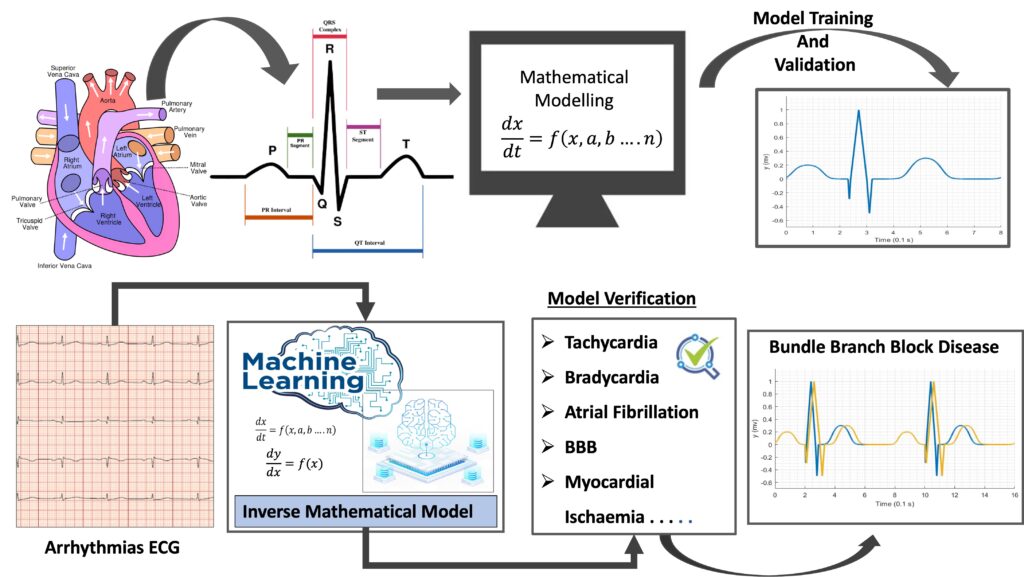
This research addresses the challenge of ECG interpretation variability by developing a mathematical model of a standardized ECG signal. This model, validated against ECGs from various arrhythmias (tachycardia, bradycardia, atrial fibrillation, bundle branch block, etc.), will allow for parameter estimation to quantify deviations from normal. These parameters will then be used in machine learning models to predict arrhythmias, potentially enabling earlier detection and improved patient outcomes.