
AI-ML in Health Care
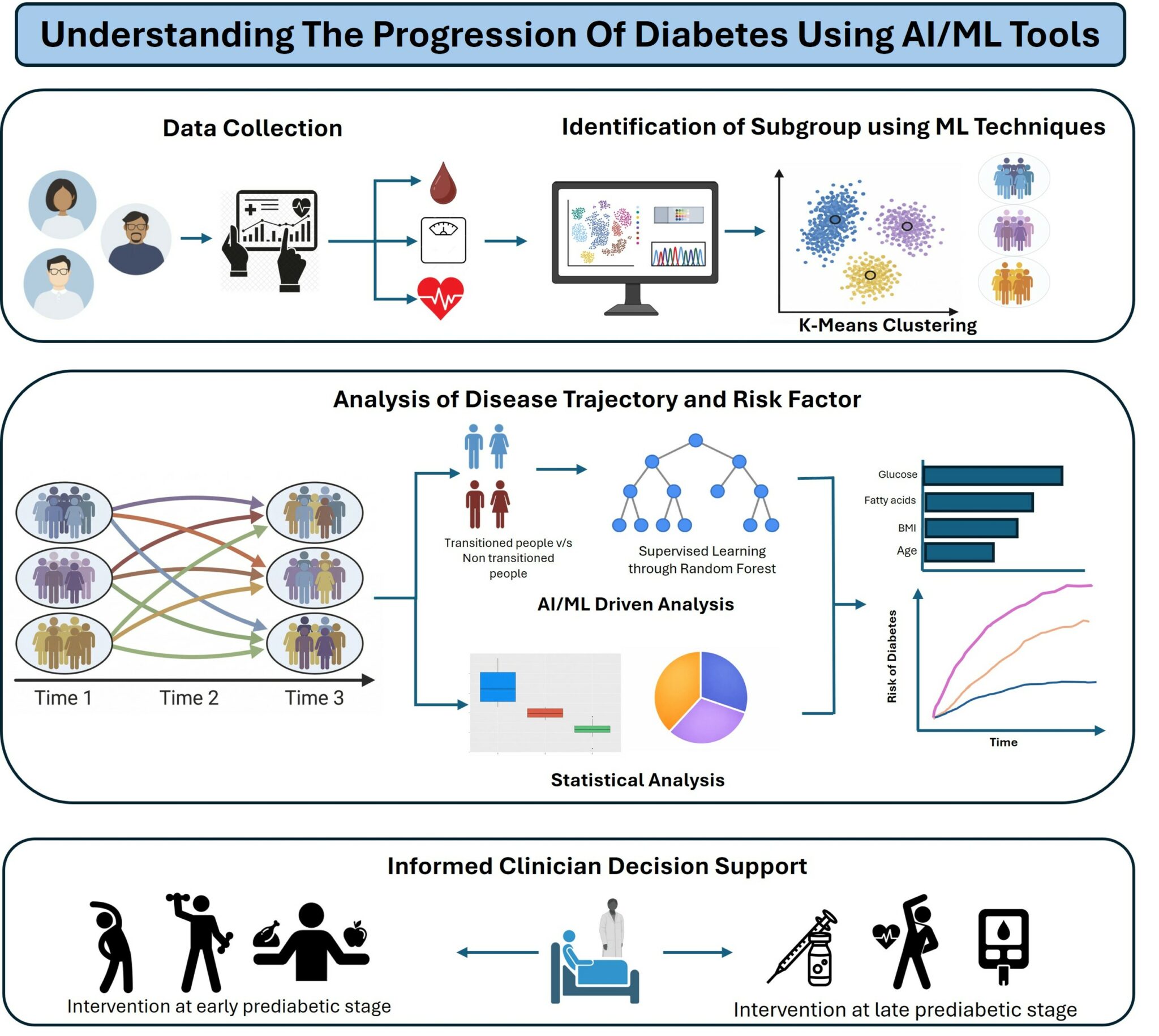
Creating a diabetes risk profile and analyzing long-term progression using advanced clustering techniques
Diabetes is a chronic metabolic disorder characterized by the body’s inability to process glucose, resulting in hyperglycemia and organ damage. The International Diabetes Federation projects that by 2045, 784 million people will be affected, an increase from 10.5% in 2021. India, known as the diabetes capital of the world, sees Type 2 Diabetes (T2D) developing at younger ages and with thinner phenotypes. Thus, effective, cost-efficient interventions to prevent or delay T2DM progression are crucial for public health.
High-risk factors for diabetes can be identified through advanced machine learning techniques, particularly clustering algorithms applied to longitudinal cohort data. This method groups individuals based on similar health characteristics, facilitating the identification of phenotypes associated with increased diabetes risk. Based on the extracted features and parameters, a model can be developed to analyze diabetes progression and the interactions of risk factors over time. The resulting insights can guide healthcare providers in making informed, data-driven decisions and developing personalized treatment plans.
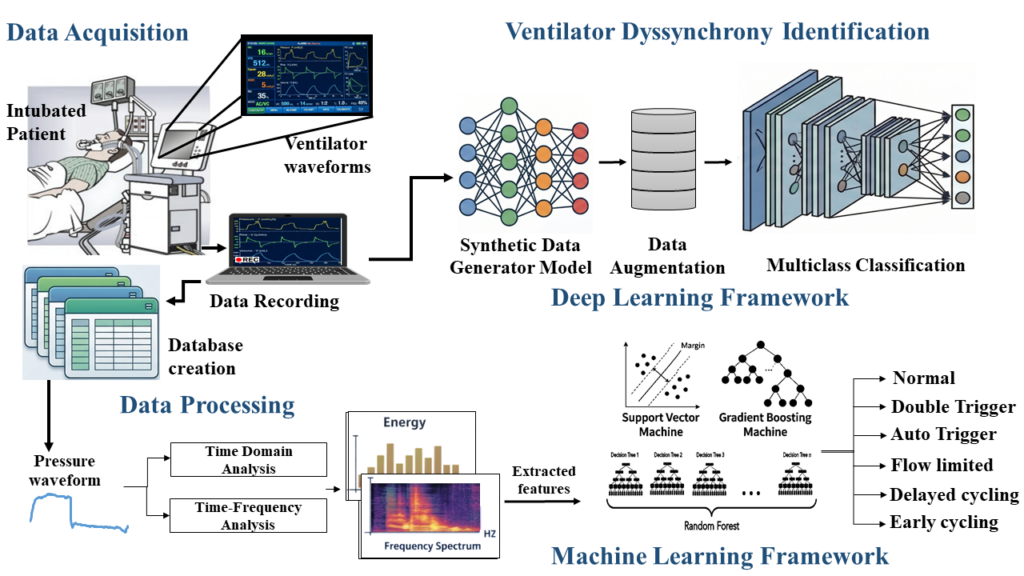
Improving the ventilator management for ICU patients
Ventilator dyssynchrony (VD) identification is crucial for preventing any lung injury that may be incurred by the patient. In view of this, we propose a signal processing-based solution for VD detection from synthetic pressure and volume data generated using a VD lung ventilator model (VDLV). Further, we will be using the Machine learning model for decision-making. Researchers are developing Deep learning based decision making systems showing good performance in training and testing in particular settings, but the same system fails in another setting. Therefore, it is important to understand what information the model is looking at. Now the researchers have tried to generate explainable AI methods to provide the insights within the model that was treated like a black box earlier, despite this, there is still a lack of understanding of what is happening inside the black box. In view of this, we are trying to analyze the underlying information present within the signal, which will further help to provide discriminative features to the ML models. This information will make it easy to interpret the model outcomes and also explain the results to the clinicians to make them trust the system.
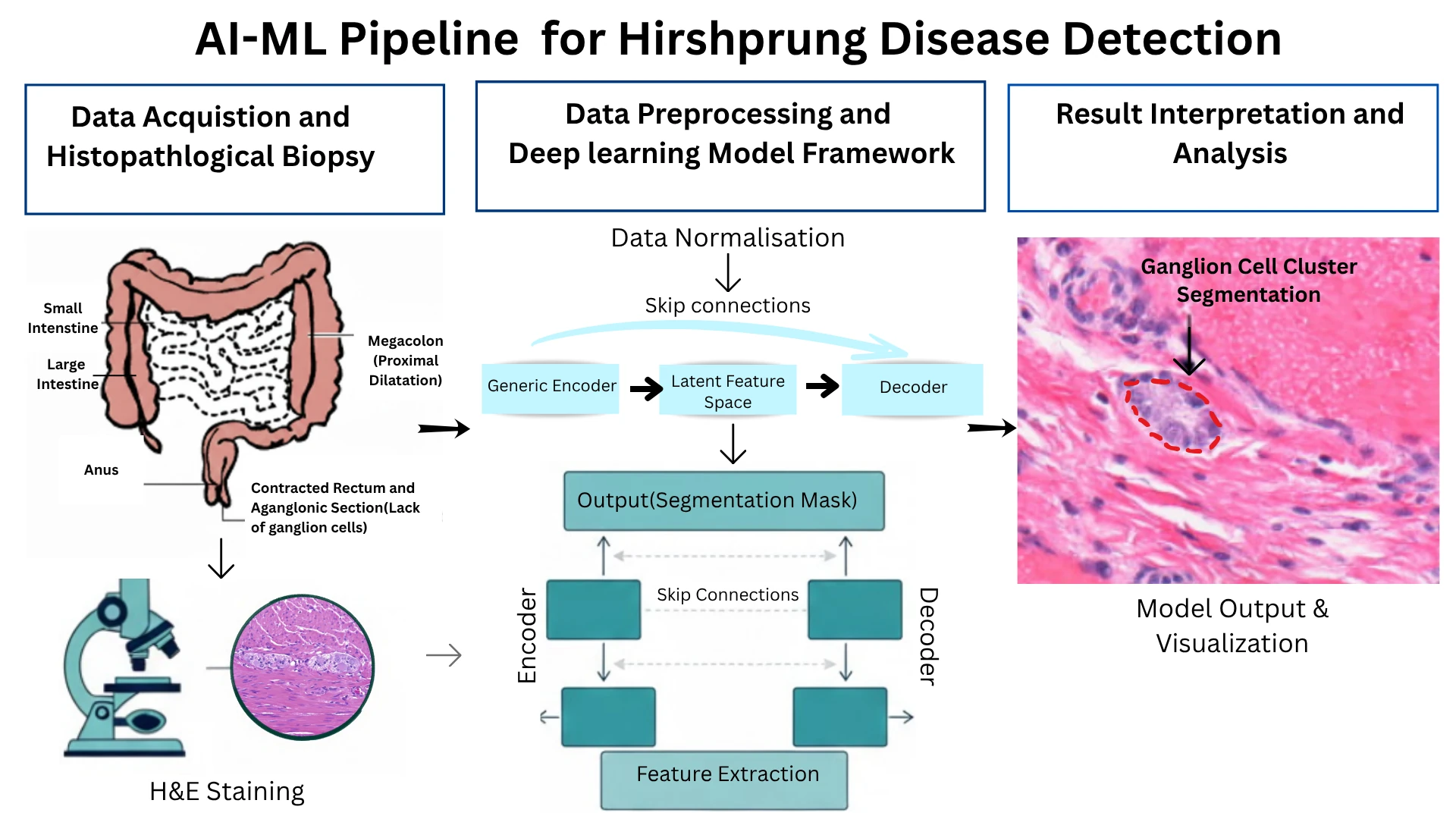
Developing AI-ML based pipeline to automate the detection of Hirschsprung disease using histopathological images
Hirschsprung disease (HD) is a congenital condition marked by the absence of ganglion cells in the colon, causing functional obstruction. Traditionally diagnosed through histopathological examination of biopsy specimens, advancements in machine learning (ML) present innovative approaches for enhancing the detection of HD via the analysis of histopathological images. ML automates image analysis, improving diagnosis efficiency, consistency, and accuracy.
Developing ML models involves collecting annotated histopathological images, normalizing and augmenting data, and using convolutional neural networks (CNNs) for feature extraction. The models are trained using supervised learning techniques and evaluated for sensitivity and specificity. A user-friendly interface can facilitate the deployment of these models, allowing pathologists to receive automated assessments.
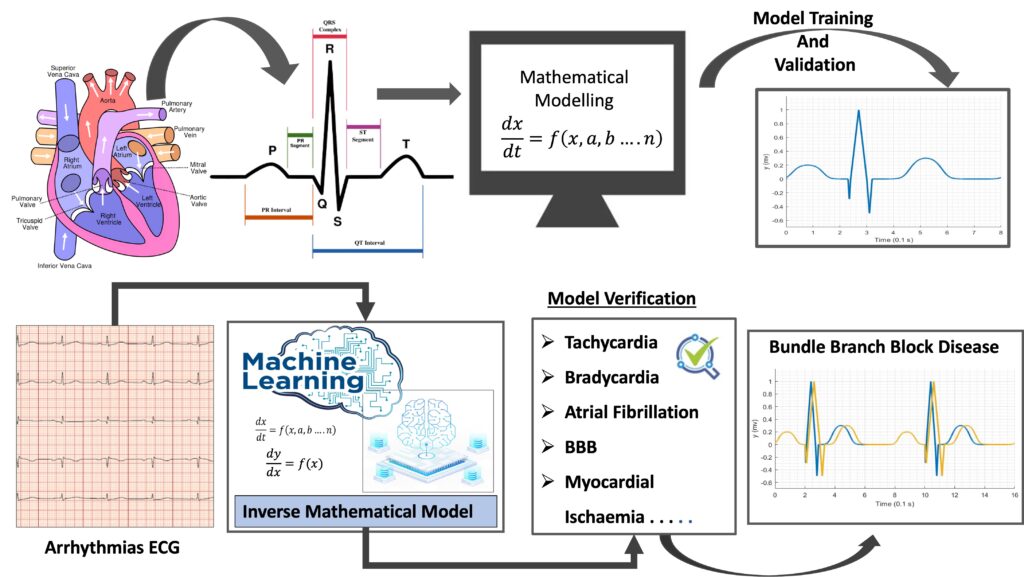
Developing data driven mathematical model to decode ECG signals
This research addresses the challenge of ECG interpretation variability by developing a mathematical model of a standardized ECG signal. This model, validated against ECGs from various arrhythmias (tachycardia, bradycardia, atrial fibrillation, bundle branch block, etc.), will allow for parameter estimation to quantify deviations from normal. These parameters will then be used in machine learning models to predict arrhythmias, potentially enabling earlier detection and improved patient outcomes.